
Blog
The Reality of Business Failure No One Talks About — A Must-Read for Every Business Owner

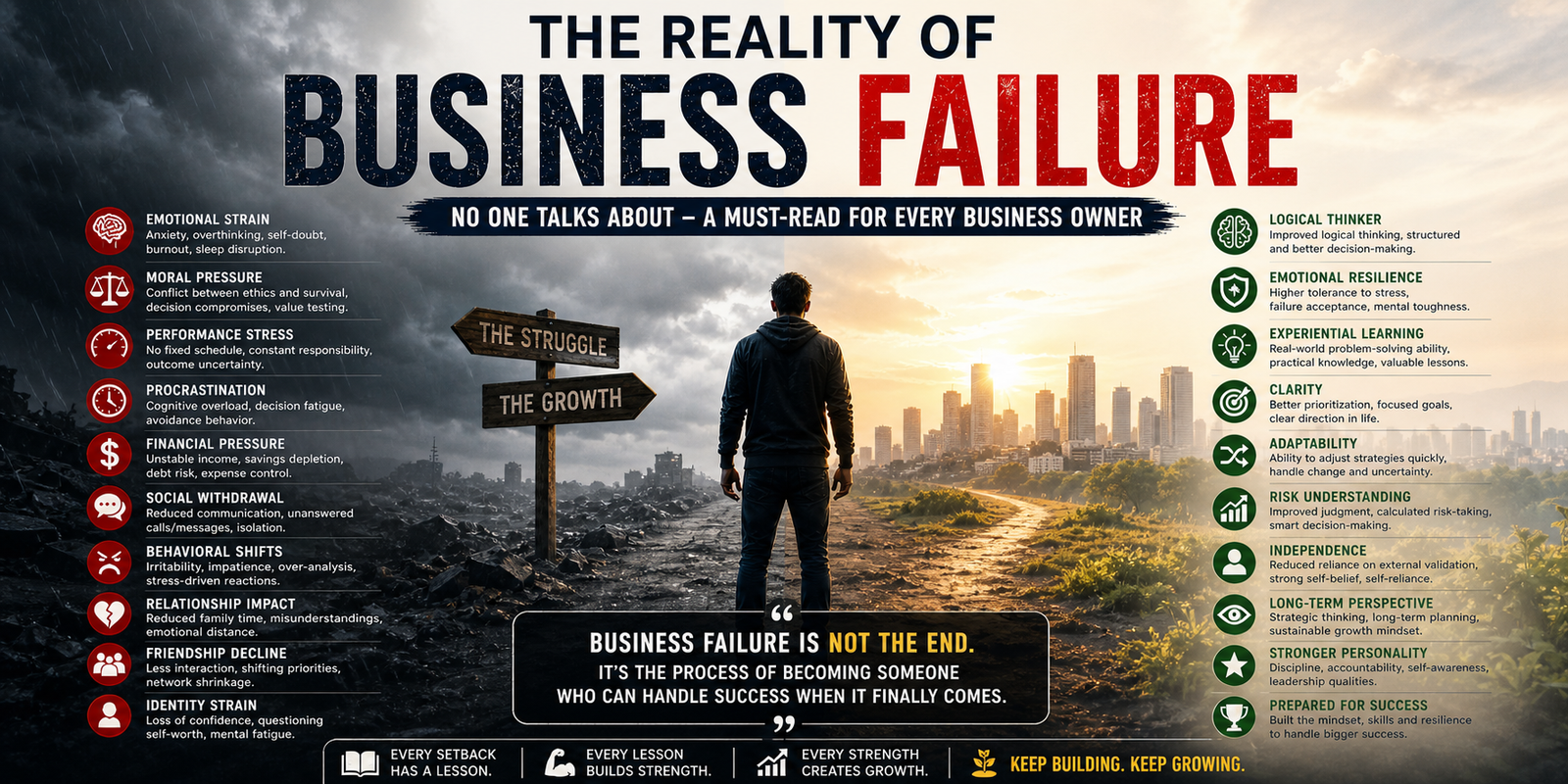
The Truth About Business Failure No One Posts About
Everyone talks about success like it's a highlight reel. But no one really talks about the silent war behind it — the part where founders break before they build.
Reading Time: 25 minutes•Last Updated: January 2025
The startup ecosystem has a transparency problem. Open any business publication, scroll through LinkedIn, or attend a founder meet-up, and you'll see the same narrative repeated endlessly: overnight successes, massive funding rounds, hockey-stick growth curves, and carefully curated images of founders who seem to have it all figured out. The business world has become a highlight reel, where every failure is reframed as a "learning experience" and every setback is dressed up as a stepping stone to greater success.
But there's a darker, more nuanced reality that rarely makes it into the public discourse. Behind every success story are years of struggle that most founders would rather forget than document. Behind every "humbled and excited" announcement are months of anxiety, self-doubt, and isolation. Behind every polished pitch deck is a human being who has questioned their sanity, their abilities, and their choices more times than they can count.
This article is an attempt to break that silence. Not to discourage aspiring entrepreneurs, but to prepare them. Not to romanticize struggle, but to acknowledge its existence. Because the truth is that entrepreneurship is not just a career choice — it's a transformation. And transformation, by its very nature, involves destruction before reconstruction.
1Emotional Breakdown — The Invisible Burn
At the beginning, you're full of fire. You believe in your idea more than anyone else. But slowly, almost imperceptibly, the fire begins to dim, replaced by a constant, gnawing pressure that most founders never anticipated.
The entrepreneurial journey often begins with an almost irrational optimism. You see an opportunity where others see obstacles. You believe in your vision with a conviction that borders on obsession. Family members might express concern, friends might offer gentle skepticism, but you press forward, fueled by the certainty that you're onto something significant. This initial phase is exhilarating — every conversation feels like it could lead to a breakthrough, every obstacle seems surmountable, and the future stretches before you full of possibility.
But then reality sets in. The product launch doesn't go as planned. Customer acquisition proves more difficult than anticipated. The runway gets shorter with each passing month. And slowly, almost imperceptibly, something begins to shift inside you.
Doubt creeps in. Sleep disappears. Anxiety becomes your daily partner. You start questioning everything: "Am I even good enough?" "What if this fails?"
The emotional toll of entrepreneurship is perhaps the most under-discussed aspect of the entire journey. While business schools teach financial modeling, marketing strategy, and operational efficiency, they rarely address the psychological marathon that founders must run. The truth is that building a business requires an emotional resilience that most people have never had to develop.
Consider the unique psychological position of a founder. In a traditional job, success and failure are distributed across an organization. If a project fails, it's the team's failure, the department's failure, maybe the company's failure. But for a founder, every failure feels personal. The business is an extension of yourself — your vision, your decisions, your execution. When things go wrong, there's no one else to blame. No organizational structure to absorb the impact. Just you, alone with your choices.
The Sleepless Nights
Ask any experienced founder about sleep during the early days, and you'll get a knowing look. The relationship between entrepreneurship and sleep disturbance is so common it's almost a cliché, but that doesn't make it any less real. Your mind becomes a theater that plays worst-case scenarios on loop: what if the funding doesn't come through? What if the key employee leaves? What if the market shifts overnight?
The cruel irony is that these sleepless nights often become self-fulfilling prophecies. Exhaustion clouds judgment. Poor judgment leads to worse decisions. Worse decisions create more problems. More problems mean more sleepless nights. The cycle perpetuates itself, and breaking free requires a conscious effort that many founders don't have the energy to make.
"I remember lying awake at 3 AM, calculating how many months of runway we had left. The numbers didn't change whether I worried about them or not, but I couldn't stop. It was like my brain had decided that if I just thought about it hard enough, somehow the money would appear. Of course, it never did. But I kept doing it anyway, night after night, until exhaustion became my new normal."
The Imposter Syndrome
Here's a truth that might surprise you: the most successful entrepreneurs often feel like they're making it up as they go along. Imposter syndrome — that persistent feeling that you're a fraud about to be exposed — is not limited to those who struggle. It affects founders at every stage of the journey, including those who, by any objective measure, are succeeding brilliantly.
The nature of entrepreneurship requires constant venturing into unknown territory. You're building something that hasn't been built before, solving problems that haven't been solved in quite this way, navigating markets that are constantly shifting. Of course you feel uncertain — you are uncertain. The problem is that this uncertainty gets interpreted not as a natural part of the process, but as evidence of personal inadequacy.
And the worst part? You can't show it. Because you're supposed to be the strong one.
The Performance of Confidence
There's a peculiar performance aspect to entrepreneurship that compounds the emotional burden. Founders are expected to project confidence — to employees, to investors, to customers, to the market. Any sign of doubt or weakness is interpreted as a red flag. So you learn to perform. You learn to say "we're making great progress" when you're terrified. You learn to present quarterly numbers with enthusiasm even when you know they're not enough. You learn to smile in meetings when you want to scream.
This performance requires enormous energy. It's like being an actor in a play that never ends, where you're always on stage, always in character, never able to drop the mask and just be the confused, scared, exhausted human being you actually are. Over time, this disconnection between your inner experience and outer presentation creates a kind of psychological fragmentation that many founders don't even recognize until years later.
The combination of sleep deprivation, chronic anxiety, imposter syndrome, and the need to constantly perform confidence creates a perfect storm for mental health challenges. Depression, burnout, and anxiety disorders are significantly more common among entrepreneurs than the general population — yet seeking help is often seen as weakness.
The Isolation Factor
Part of what makes the emotional burden of entrepreneurship so heavy is that it's carried largely alone. In a traditional job, you have colleagues who understand your work context. You can vent about your boss, complain about company politics, share the burden of difficult projects. But as a founder, who do you talk to?
Your employees look to you for stability and direction. Sharing your fears with them would undermine confidence in your leadership. Your investors want to see progress and potential. Sharing your doubts with them might cost you their support. Your family may not fully understand what you're going through, or worse, may be directly affected by the financial instability of your venture. Your friends from before the business might offer sympathy, but they can't truly relate to the unique pressures you face.
So you keep it inside. You become your own therapist, your own confidant, your own support system. And while this can build enormous strength, it can also lead to a dangerous psychological isolation where problems seem larger than they are and solutions seem further out of reach.
The emotional journey of entrepreneurship is not a bug in the system — it's a fundamental feature of the process. Understanding this doesn't make it easier, but it does help normalize the experience. You're not broken for feeling this way. You're going through something that would challenge any human being.
2Moral Conflict — Right vs Survival
You start with values. Strong ones. But business tests them in ways you never anticipated. The real test of character isn't what you do when things are going well — it's what you do when survival itself is on the line.
Most entrepreneurs begin their journey with a clear moral compass. They want to build something valuable, treat people fairly, contribute to society, and succeed on their own terms. These values often feel non-negotiable — core principles that will guide every decision regardless of circumstances. But the reality of building a business in a competitive market, with limited resources and mounting pressures, tests these principles in ways that no ethics textbook can prepare you for.
The moral challenges of entrepreneurship rarely come as dramatic, movie-worthy dilemmas. They come as small, cumulative decisions that each seem justifiable in isolation but slowly reshape who you are and what your business stands for. They come when you're tired, stressed, and desperate. They come when the "right" choice might mean the end of everything you've built.
The Payment Dilemma
One of the most common moral tests comes around payments and cash flow. Your business is running low on funds. Payroll is due. You have invoices from vendors that are also due. And you have to make a choice.
The Pressure
Do you delay payments to vendors to ensure your employees get paid? After all, your team depends on their salaries for rent, food, and family support. A delayed vendor payment might strain a relationship, but a missed payroll could destroy lives.
But what about the vendor? They're a small business too, with their own payroll to meet, their own families to support. Your delay becomes their crisis.
The Real Cost
These decisions often get made in survival mode, without full consideration of the ripple effects. But each choice shapes who you become as a business leader. Each rationalization makes the next one easier.
The vendors who wait, the employees who don't know how close they came to not being paid — they remember. Trust gets built or destroyed in these invisible moments.
The Overpromise Trap
Sales is the lifeblood of any business, and in the early days, every sale feels crucial. The pressure to close deals can lead to a subtle erosion of honesty in how products and services are presented. It starts small — exaggerating a timeline here, minimizing a limitation there, implying capabilities that aren't quite ready yet. Each decision seems minor, justifiable as "marketing" or "positioning."
But these small compromises accumulate. Customers who feel misled become detractors. Employees who see the gap between promises and reality lose faith in leadership. The business that started with a commitment to transparency becomes something murkier. And somewhere along the way, the founder who swore they would always be honest can't quite pinpoint when they became someone who bends the truth.
You realize: Doing business is not just about growth — it's about staying ethical when survival is on the line. That's where real character is built.
The Corner-Cutting Cascade
Every industry has its corners that can be cut. In software, it might be skipping thorough testing to meet a launch date. In food service, it might be using cheaper ingredients during a tight month. In consulting, it might be overbilling hours to make up for unbillable work. The specific corners vary, but the pattern is universal: pressure creates temptation, and temptation creates rationalization.
The dangerous truth about corner-cutting is that it rarely feels like a major moral failure in the moment. It feels like pragmatism, like realism, like doing what's necessary to survive. And sometimes, it works — the launch succeeds despite the skipped testing, the customers don't notice the cheaper ingredients, the client accepts the billing without question. When corner-cutting succeeds, it reinforces itself. You begin to believe that this is just how business works.
But eventually, corners cut become debts owed. The technical debt from skipped testing causes a major outage. The ingredient quality issue becomes a health concern. The billing discrepancy triggers an audit. The bill comes due at the worst possible moment, often when the business can least afford it.
The Employee Dilemma
Perhaps the most painful moral challenges involve the people who have bet their careers on your vision. When a business is struggling, the hardest decisions often involve employees who have given years of their lives to help build something. Do you lay off loyal team members to preserve cash? Do you cut benefits to avoid terminations? Do you share the full truth about the company's situation, knowing it might cause your best people to leave?
"I had to let go of someone who had been with us from the beginning. She'd taken a pay cut to join us, worked nights and weekends, believed in what we were building. When I sat her down for that conversation, I could see her trust shatter. Not just in the company, but in me personally. She'd put her faith in my leadership, and I was telling her that faith had been misplaced. The worst part was that I couldn't even disagree with her conclusion."
The Competitive Landscape
Business doesn't happen in a vacuum. Every decision you make exists in a competitive context where others may be playing by different rules. When competitors exaggerate their capabilities, undercut prices unsustainably, or engage in practices that you find ethically questionable, the pressure to match them can be intense. If playing fair means losing to those who don't, is fairness really the right choice?
This is where many founders find their values tested most severely. The market doesn't reward purity — it rewards results. And when results seem to come more easily to those with flexible ethics, staying true to your principles can feel not just difficult but foolish. This is the crucible where character is either forged or abandoned.
Here's what years in business teach you: the shortcuts that seem to work in the short term almost always extract a heavier price in the long term. The competitors who cut corners eventually face the consequences. The relationships damaged by compromised values take years to rebuild if they can be rebuilt at all. The reputation lost through ethical lapses closes doors that might otherwise have opened. Character, it turns out, is not just a moral virtue but a business asset with compounding returns.
3Performance Pressure — Always "On"
There is no off switch. No fixed working hours. No guaranteed salary. No safety net. Every day feels like a performance review — except the judge is the market, and the market doesn't care about your effort. Only results.
The traditional concept of "work-life balance" becomes almost meaningless in the entrepreneurial context. When you're building something from nothing, there's no clear boundary between work and life. The business is not something you do; it's something you are. This integration of identity and enterprise creates a pressure that never fully lifts, a constant sense that you should be doing more, that every moment not spent on the business is somehow wasted.
The Comparison Trap
In the age of social media and startup media, entrepreneurs are constantly bombarded with images of success. Funding announcements, product launches, growth metrics, speaking engagements — the highlight reels of other founders are always visible, always impressive. The natural tendency is to compare your behind-the-scenes reality with everyone else's public victories.
This comparison is not just demoralizing; it's fundamentally distorted. You're comparing your complete reality — the doubts, the setbacks, the late nights, the anxieties — with a carefully curated presentation that shows only the highlights of others. It's like comparing your actual life to a movie where every scene is the climax. Of course you come up short. But recognizing this distortion doesn't make it less painful in the moment.
The Constant Judgment
Unlike most jobs where performance is evaluated periodically — quarterly reviews, annual assessments — entrepreneurship feels like constant judgment. Every customer interaction is a verdict on your product. Every sales conversation is a test of your value proposition. Every investor meeting is an evaluation of your worthiness. Every social media post is judged for engagement. Every competitor move is a commentary on your strategy.
This relentless feedback loop creates a hypervigilance that's exhausting to maintain. You become attuned to the slightest signals of approval or disapproval, reading significance into every data point. A dip in website traffic feels like a referendum on your business. A negative comment on a post feels like a rejection of your vision. Without the buffer of an organization to absorb these judgments, they hit you directly and personally.
The Decision Fatigue
Entrepreneurs make more decisions in a week than many employees make in a year. Product features, pricing, hiring, firing, marketing strategies, partnership terms, customer responses, investor relations — every day brings dozens of choices, each with consequences that feel significant. Over time, this constant decision-making depletes a finite cognitive resource.
Decision fatigue manifests in predictable ways: avoidance of difficult choices, impulse decisions just to end the uncertainty, deterioration in the quality of choices made later in the day. Many founders find themselves unable to make simple personal decisions — what to eat for dinner, what movie to watch — because their decision-making capacity has been exhausted by business choices.
The combination of constant judgment, decision fatigue, and never-ending pressure creates the conditions for burnout. But unlike employees who can change jobs, founders can't easily walk away. The business represents not just income but identity, investment, and hope. This makes burnout more likely and recovery more difficult.
The Market's Indifference
Perhaps the most humbling aspect of entrepreneurship is the discovery that the market is utterly indifferent to your effort. In school, hard work is usually rewarded. In many jobs, visible effort is at least acknowledged. But in business, the market cares only about results. You can work yourself to exhaustion, sacrifice everything, believe with every fiber of your being — and still fail. The market doesn't reward effort. It rewards value delivered to customers, and even that reward is competitive and temporary.
This indifference can feel cruel, especially for founders who have invested everything. But it's also clarifying. The market's feedback, however harsh, is honest in a way that other environments rarely are. Either you're creating value that people will pay for, or you're not. Either you're executing effectively, or you're not. The numbers don't lie, and they don't care about your feelings.
4Procrastination — The Silent Killer
Not laziness. Not lack of ambition. But mental overload. When everything depends on you, decisions get delayed, tasks pile up, and fear disguises itself as "I'll do it tomorrow." And tomorrow becomes a pattern.
Entrepreneurs are often characterized as highly motivated, action-oriented individuals who make things happen. Yet many founders struggle with procrastination that seems to contradict this image. Understanding the roots of entrepreneurial procrastination reveals a complex psychological phenomenon that has nothing to do with laziness and everything to do with the overwhelming nature of building something from nothing.
The Paralysis of Everything
In a traditional job, responsibilities are bounded. You have a role, a set of tasks, a defined scope. But a founder's responsibilities are essentially unbounded. Everything is potentially your job: product development, sales, marketing, operations, finance, HR, legal compliance, customer support, and a hundred other functions that most people don't even think about until they become urgent.
This unlimited scope creates a unique form of paralysis. When everything is important, how do you prioritize? When every task not done could be the critical one, how do you justify doing anything? The weight of infinite possibility can crush forward motion entirely.
- The feature that might attract enterprise customers needs development
- The blog post that might drive organic traffic needs writing
- The partnership that might open new markets needs cultivation
- The team member who needs guidance needs your time
- The investor who might fund the next round needs updating
Each task seems equally urgent, equally important. The result? None of them get done well, or sometimes at all.
Fear in Disguise
Beneath the surface of entrepreneurial procrastination often lies a complex web of fears. Fear of making the wrong decision. Fear of discovering that your assumptions were wrong. Fear of confronting the gap between your vision and reality. Fear of the effort required to pursue something that might not work.
These fears rarely announce themselves honestly. Instead, they manifest as busywork — tasks that feel productive but avoid the truly important work. You might find yourself obsessively checking emails, reorganizing files, tweaking website copy, or researching competitors. These activities create an illusion of progress while avoiding the uncomfortable work that actually moves the business forward.
The procrastination paradox: founders often procrastinate most on the tasks that matter most, because those tasks carry the greatest weight of expectation and fear.
The Decision Delay Pattern
One of the most damaging forms of entrepreneurial procrastination involves decisions themselves. The reasoning often goes: "I need more information before I can decide." And indeed, more information might improve decision quality. But in business, information has costs — time costs, opportunity costs, sometimes financial costs. The decision delayed often costs more than the decision made imperfectly.
The pattern typically unfolds like this: a decision needs to be made. The stakes feel high. You research, analyze, seek opinions, consider alternatives. Meanwhile, the window for action narrows. Options that were available yesterday close today. Competitors move while you deliberate. The cost of delay compounds, but the decision still needs to be made. Eventually, circumstances force a choice that might have been better made with deliberate intention weeks earlier.
Breaking the Pattern
Overcoming entrepreneurial procrastination requires a fundamental shift in how you relate to tasks and decisions. The most effective founders develop systems that compensate for their natural tendencies: time-blocking for important work, accountability partners for key tasks, explicit deadlines even when external ones don't exist, and a practice of making decisions with imperfect information. The goal is not to eliminate procrastination entirely — that's probably impossible — but to recognize it quickly and have structures in place to move through it.
5Financial Stress — The Real Weight
This is where it hits hardest. Savings disappear. Loans increase. Revenue is unpredictable. You stop spending on yourself. You calculate every rupee. And sometimes, you lie to your own family: "Everything is going well."
Money is the raw material of business, and its scarcity is the constant companion of most early-stage entrepreneurs. The financial stress of building a business affects not just the enterprise but every aspect of a founder's life: their relationships, their health, their self-image, their hopes for the future. It's a weight that doesn't lift at the end of the workday because it's woven into the fabric of daily existence.
The Personal Finance Collision
One of the most immediate impacts of starting a business is the collision between business finances and personal finances. In the early days, the two are often indistinguishable. Personal savings fund the business. Personal credit cards bridge cash flow gaps. Personal guarantees back business loans. The entrepreneur's financial fate becomes inseparable from the business's fate.
This integration creates a psychological pressure that's difficult to explain to those who haven't experienced it. Every business expense is also a personal expense, in a sense. Every dollar spent on the business is a dollar not available for personal needs. The calculus becomes constant and exhausting: can I justify this? Is this necessary? Is there a cheaper way?
The Income Uncertainty
Traditional employment offers predictable income. You know what you'll earn, when you'll receive it, and you can plan accordingly. Entrepreneurship offers no such certainty. Revenue might surge one month and collapse the next. Large deals might close after months of effort or fall through at the last moment. The financial roller coaster creates a background anxiety that never fully disappears.
The Lifestyle Compression
Most entrepreneurs experience a significant lifestyle compression in the early years of their business. Expenses that once seemed routine become luxuries. Dinners out become rare occasions. Vacation plans get postponed indefinitely. Major purchases — cars, homes, even furniture — get deferred to some indefinite future when the business is "stable."
The Family Impact
The financial stress of entrepreneurship doesn't affect only the founder. It ripples outward to partners, children, and extended family. Spouses may need to work longer hours to compensate for reduced household income. Children's activities may be limited due to budget constraints. Family vacations may be cancelled or downgraded. The cumulative effect on family life can be significant and, in some cases, devastating to relationships.
"My wife and I used to dream about buying a house. When I started the business, we postponed that dream by 'a year or two.' Five years later, we were still renting, still uncertain, still pouring everything into a business that seemed to need more each year. I could see the disappointment in her eyes when friends bought homes, went on vacations, lived the life we had planned. The business was my dream, but it was becoming our shared sacrifice, and I wasn't sure that was fair to ask."
The Deception Trap
One of the most painful aspects of entrepreneurial financial stress is the pressure to maintain appearances. You might be struggling to pay your own salary, but you don't want employees to know — it would damage morale and confidence. You might be weeks away from insolvency, but you don't want investors to know — it would complicate future funding. You might be deeply worried about the future, but you don't want family to know — it would add their anxiety to yours.
So you develop the skill of appearing fine when you're not. You learn to talk about the business in optimistic terms even when you're terrified. You learn to deflect questions about finances with vague reassurances. And slowly, almost imperceptibly, you become someone who lies about the most fundamental aspects of your life. The people closest to you see a version of reality that doesn't match your actual experience. This creates a profound isolation at the very moment you most need connection.
The Recovery Challenge
Even when businesses succeed financially, the years of financial stress leave their mark. Many successful entrepreneurs report lasting anxiety about money even after achieving significant wealth. The habits of scarcity — calculating every expense, hesitating before purchases, fearing financial instability — become deeply ingrained and difficult to unlearn. The psychological impact of financial stress can persist long after the material conditions that created it have changed.
Financial stress in entrepreneurship is not a sign of failure — it's a near-universal experience. Understanding this doesn't make the stress less real, but it can help founders recognize that they're not alone in their struggles and that the financial challenges they face are part of the process, not evidence that they're doing something wrong.
6Ghosting Friends & Messages — Isolation Mode
You don't reply. Not because you don't care, but because you don't have energy, you don't have good news, and you don't want to explain your struggle. Slowly, calls go unanswered, messages stay unread, and invitations get ignored. You isolate yourself.
The isolation of entrepreneurship develops gradually, almost without notice. It starts with being too busy to respond to a message. Then it's skipping a social event because something urgent came up. Then it's realizing you haven't spoken to your best friend in weeks. Then it's noticing that the invitations have stopped coming because people assumed you wouldn't accept anyway. The business that consumed your time begins to consume your relationships as well.
The Energy Equation
Every social interaction requires energy. For entrepreneurs who are already depleted by the constant demands of their business, this energy cost becomes significant. A dinner with friends means hours of presence plus emotional energy to engage, to listen, to contribute. A phone call means time away from work plus the mental load of explaining what's happening in your life.
When you're already exhausted, when your mind is constantly racing with business concerns, when the idea of making conversation feels daunting, the natural response is to withdraw. It's not that you don't value these relationships — you do. It's that you don't have the resources to maintain them. You're running on reserves, and social interaction is a luxury you can't currently afford.
The Good News Problem
There's another factor that complicates social relationships during the entrepreneurial journey: the desire to have good news to share. When people ask "How's the business going?" you want to have a positive answer. You want to talk about growth, success, exciting developments. When the reality is struggle and uncertainty, these conversations become painful.
- You don't want to lie, but you also don't want to burden friends with your worries
- You don't want to seem negative, but you also don't have anything positive to share
- You don't want to explain the complexities, but you also can't give a simple answer
- You don't want to seem like you're complaining, but you also need support
The result? You avoid the conversations entirely by avoiding the people who would have them.
The Understanding Gap
Even when you do open up to friends about the entrepreneurial experience, there's often an understanding gap that makes these conversations unsatisfying. Friends from traditional jobs may not fully grasp the pressures you're under. They might offer well-meaning advice that doesn't apply to your situation. They might minimize challenges or over-simplify solutions. They might express concern in ways that feel like judgment.
Over time, you learn that explaining your reality to people who haven't experienced it takes enormous energy and rarely produces the understanding you're seeking. It's easier to stay surface-level, to talk about other things, to keep the business part of your life private. And so the isolation deepens.
You isolate yourself. Not intentionally. But life shifts: different priorities, different struggles, different mindset. Some friends stay. Many don't. And you learn: not everyone is meant to walk the entire journey with you.
The Friendship Fading
What often happens to entrepreneurial friendships is a slow fading rather than a dramatic break. There's no argument, no falling out, no clear moment when the friendship ends. There's just less contact, longer gaps between conversations, fewer shared experiences. Both parties still consider each other friends, but the relationship exists more in memory than in present reality.
This fading is particularly painful because it's often preventable in theory but inevitable in practice. You could make time for friends — you choose not to, or more accurately, you choose other priorities. They could reach out more — they eventually stop because it seems one-sided. Neither party is wrong, but the relationship suffers nonetheless.
7Behavioral Changes — You're Not the Same Person
People notice it before you do. Short temper. Overthinking. Less patience. Constant stress. You become more serious. More guarded. Because you're carrying something no one else fully understands.
The entrepreneurial journey changes you. This transformation is perhaps inevitable — any significant undertaking that demands years of focus and sacrifice will reshape the person undertaking it. But the nature and direction of this change often surprise both the entrepreneur and those around them. The person who emerges from the crucible of building a business is recognizable but different, carrying marks that may never fully fade.
The Patience Erosion
One of the most commonly reported changes among entrepreneurs is a decrease in patience. When every moment matters, when efficiency is survival, when you're constantly operating at the edge of your capacity, you become less tolerant of anything that wastes time. Slow service, inefficient processes, meandering conversations — these frustrations hit harder because your margins for frustration have been depleted by business challenges.
This impatience extends to personal relationships in ways that can be damaging. Partners may feel that you're always in a hurry. Friends may notice that you check your phone constantly during conversations. Family members may experience your shortened attention span as disinterest. The very qualities that help you succeed in business — urgency, focus, efficiency — become liabilities in the parts of life that require presence and patience.
The Guarded Self
Entrepreneurship often produces a more guarded personality. The experience of having ideas stolen, relationships exploited, or confidence betrayed creates a protective shell. You learn to share less, trust more slowly, and reveal yourself more cautiously. This guardedness is a rational adaptation to the competitive environment of business, but it affects all relationships, not just business ones.
The transformation is often noticed first by those closest to you. A spouse might remark that you seem more distant. A parent might observe that you're less open about your life. A long-time friend might comment that they don't really know what's going on with you anymore. These observations reflect a real change — you have become someone who holds more inside, who processes more privately, who presents a more curated version of yourself to the world.
Before Entrepreneurship
Open, optimistic, patient with life's pace, present in conversations, able to relax, defined by relationships and interests outside work, comfortable with uncertainty in the future.
After Entrepreneurship
Guarded, realistic to the point of cynicism, impatient with inefficiency, always partially present, difficulty relaxing, identity merged with venture, anxious about future outcomes.
The Seriousness Settling
Many entrepreneurs report becoming more serious over time. The levity and lightness that characterized their pre-entrepreneurial personality give way to a more sober approach to life. This isn't depression, necessarily — it's a recognition of stakes, an awareness of consequences, a integration of the weight of responsibility into your baseline personality.
This seriousness can be confusing to friends and family who remember a different version of you. They might ask why you never joke around anymore, why you seem always focused on business, why you can't just relax and enjoy things. The question reflects a genuine change, but one that's difficult to explain because it happened so gradually, because it reflects a genuine shift in how you see the world, not a temporary mood.
While some personality changes are inevitable and even adaptive for entrepreneurship, others can signal mental health challenges. If changes include persistent sadness, inability to enjoy previously pleasurable activities, significant sleep disruption, or thoughts of self-harm, professional support should be sought. Entrepreneurship is demanding, but it shouldn't destroy your fundamental wellbeing.
8Relationships Take the Hit
This is where it hurts the most. Family doesn't always understand your risk. Partner feels neglected. Friends think you've changed. And maybe you have. Because when you give everything to your business, something else always pays the price.
The impact of entrepreneurship on relationships is perhaps its most significant human cost. Businesses can be rebuilt after failure. Money can be earned again after loss. But relationships damaged during the entrepreneurial journey may never fully recover. Years of neglect, broken promises, and emotional absence create wounds that even eventual success cannot heal.
The Partner Experience
For entrepreneurs in committed relationships, the partner often bears the brunt of the entrepreneurial burden. They may have expected a certain lifestyle that doesn't materialize. They may have anticipated more time together, not less. They may have imagined being first priority, only to discover they're competing with a business for attention and energy.
The partnership dynamics shift in ways that can be difficult to navigate. The entrepreneur becomes less reliable — missing family events, working through weekends, being physically present but mentally absent. The partner may need to shoulder more household responsibility, provide more emotional support, and accept more uncertainty than they bargained for. This imbalance can breed resentment, distance, and eventually, relationship breakdown.
"I knew marrying an entrepreneur would mean some sacrifices. What I didn't expect was how completely the business would consume him. He was there, but he wasn't there. His body was at the dinner table, but his mind was on a term sheet. We were in the same bed, but he was up at 2 AM answering emails. I became an afterthought in my own marriage, and by the time the business succeeded enough for him to have time for us, I'd already emotionally moved on."
The Family Friction
Parents and extended family often struggle to understand the entrepreneurial path. For generations raised with the ideal of stable employment and predictable career progression, the risk and uncertainty of entrepreneurship can seem irresponsible. Parents may express worry that feels like criticism. Siblings may compare your "unstable" path to their "practical" choices. Family gatherings become occasions for questions that feel judgmental: "How's the business?" "Are you making money yet?" "When are you going to get a real job?"
These family dynamics add another layer of stress to the entrepreneurial journey. At the very time you most need family support, their questions and concerns can feel like doubt. At the very time you're most vulnerable to judgment, their comparisons can feel like criticism. The result is often distance — fewer family visits, shorter conversations, more careful selection of what to share.
The Friend Filtering
The entrepreneurial journey has a way of filtering friendships. Some friends will prove incredibly supportive, making extra effort to stay connected, offering encouragement during difficult times, celebrating successes as if they were their own. These friendships often deepen through the entrepreneurial experience, becoming touchstones of support and understanding.
But other friendships will not survive the journey. Some friends will drift away as your lives diverge. Some will be unable to relate to your challenges and will offer well-meaning but unhelpful advice. Some may even seem threatened by your ambition or resentful of your focus. The filtering process can be painful — watching friendships fade that you once thought would last forever — but it also reveals which relationships are truly substantial.
Here's what experienced entrepreneurs eventually learn: relationships are not obstacles to business success; they're the foundation of sustainable success. The founders who actively invest in maintaining key relationships — scheduling date nights, protecting family time, nurturing friendships — often build more resilient businesses because they have support systems that sustain them through the inevitable challenges.
9Friendship Fades — The Quiet Distance
You stop talking. Not intentionally. But life shifts: different priorities, different struggles, different mindset. Some friends stay. Many don't. And you learn: not everyone is meant to walk the entire journey with you.
The fading of friendships during entrepreneurship is one of its quietest but most painful costs. Unlike a business failure that makes noise, the loss of friendship happens in silence — unanswered texts accumulating, calls going to voicemail, invites eventually stopping. By the time you notice what's happened, years may have passed, and the relationships may be damaged beyond easy repair.
The Priority Problem
Every friendship requires investment — time, attention, shared experiences. When entrepreneurship consumes your available investment capital, friendships become casualties of resource allocation. You don't consciously decide that friends are less important than business; you simply find that there's not enough of you to go around.
The priority shift manifests in small ways that compound over time. A birthday dinner you miss because of a work crisis. A weekend trip you skip because you can't afford the time away. A phone call you don't return because you're exhausted. Each individual choice seems justifiable, but collectively, they communicate that the friendship is not a priority. Eventually, friends stop making the effort that isn't being reciprocated.
The Mindset Gap
Beyond the practical challenges of time and energy, entrepreneurs often develop a mindset that can create distance from non-entrepreneur friends. The experience of building something from nothing, of taking full responsibility for outcomes, of operating with high stakes and constant pressure, changes how you see the world. Conversations about office politics, career ladder climbing, or work-life balance can feel foreign, even trivial, compared to what you're dealing with.
This isn't superiority — it's just different worlds. Your friends' challenges are real and significant to them, but they may not resonate with your current reality. And vice versa — your challenges may seem distant and dramatic to friends living more conventional lives. The common ground that once sustained friendships shrinks, leaving less basis for connection.
The friendships that survive the entrepreneurial journey are often those with people who can maintain connection across difference — who can be interested in your world without fully understanding it, who can share their own life without expecting you to relate to every detail, who can simply be present without needing the relationship to look like it once did.
The Acceptance
Eventually, most entrepreneurs come to a kind of acceptance about friendship changes. They recognize that the journey they've chosen has natural costs, and that relationship changes are among them. They learn to appreciate the friendships that remain without resenting those that faded. They understand that some people are meant for certain seasons of life, not the entire journey.
This acceptance doesn't eliminate the loss, but it integrates it into a larger understanding. The friendships that matter most will survive the entrepreneurial pressures — and those that don't might not have been as strong as you believed. The clarity that comes from this realization is painful but ultimately clarifying.
10When You Give It All… What Do You Get Back?
Here's the real answer — not money, not success, at least not immediately. You get transformed. You become something you couldn't have become any other way. And that transformation is the real asset.
After all the struggle, the doubt, the isolation, the financial stress, and the relationship costs — what remains? If the business fails, was it all wasted? If success comes at great personal cost, was it worth it? These questions don't have simple answers, but examining what entrepreneurs actually gain from the journey reveals a transformation that transcends conventional measures of success and failure.
A Sharper Thinker
The entrepreneurial crucible produces sharper thinking. Decisions become faster and clearer, not because the problems become easier, but because you've developed the capacity to process complexity more efficiently. You learn to distinguish signal from noise, to identify the one or two variables that actually matter among dozens of distractions, to make choices under uncertainty without being paralyzed by it.
This sharpening of thought processes is perhaps the most universally valuable outcome of the entrepreneurial experience. Whether the business succeeds or fails, you've developed a way of thinking that transfers to any future endeavor. You've learned how to analyze situations, weigh options, anticipate consequences, and commit to action. This mental acuity becomes a permanent asset, a tool you carry forward into whatever comes next.
Emotionally Stronger
The emotional challenges of entrepreneurship — the anxiety, the doubt, the isolation — also produce a kind of strength that's difficult to develop any other way. You learn that you can endure more than you thought possible. You discover reserves of resilience that only emerge under pressure. You become someone who doesn't break easily because you've already been through experiences that would have broken your previous self.
This emotional strength doesn't mean becoming numb or unfeeling. It means developing a different relationship with difficult emotions — understanding them as temporary states, not permanent conditions; recognizing that anxiety doesn't have to prevent action; knowing that you can function effectively even when you're scared. This emotional resilience is perhaps the most valuable psychological asset an entrepreneur develops.
The Transformation
Before entrepreneurship, you might have avoided discomfort, sought certainty before action, and defined yourself partly by external validation. After the entrepreneurial journey, you become more comfortable with discomfort, more able to act without certainty, and more internally referenced in your self-worth.
The Permanent Asset
Unlike skills that can become obsolete, emotional strength transfers to any context. Whether you start another business, take a job, pursue a different path entirely — you carry with you the knowledge that you can face difficulty and continue forward. This self-knowledge becomes a foundation for everything that follows.
Logically Driven
Entrepreneurship forces a kind of logical rigor that's rare in other contexts. When resources are limited and stakes are high, emotional decision-making becomes a luxury you can't afford. You learn to separate what you want to be true from what the evidence suggests is true. You develop the capacity to make choices based on logic even when they conflict with your preferences.
This logical orientation doesn't mean suppressing emotion — emotions contain important information and drive motivation. It means developing the capacity to see clearly, to evaluate options dispassionately, to choose based on expected outcomes rather than wished-for outcomes. This clarity of thought, developed through the trial of entrepreneurship, serves you in every domain of life.
Resilient
Resilience is not just the ability to recover from setbacks — it's the ability to continue forward despite them. Entrepreneurship is essentially a resilience-building boot camp. You face setback after setback: rejected pitches, lost deals, failed products, departed employees. And you continue. What else can you do? The business doesn't build itself.
This resilience becomes part of your character. You learn that failure is not fatal, that obstacles are surmountable, that problems have solutions even if you can't currently see them. This is not blind optimism — it's earned confidence based on the evidence of your own experience. You've survived difficult things before; you can survive difficult things again.
Self-Aware
Perhaps most importantly, the entrepreneurial journey produces profound self-awareness. You learn your actual strengths — not the ones you hoped you had, but the ones that prove reliable under pressure. You learn your actual weaknesses — not the ones you admitted in job interviews, but the ones that caused real problems when the stakes were high. You learn how you function under stress, what conditions you need to perform at your best, what triggers your worst impulses.
This self-knowledge is invaluable, and it's difficult to gain any other way. In a job, you can often avoid confronting your limitations because failures are absorbed by the organization. In entrepreneurship, your limitations are constantly exposed. You can't hide from yourself when you're the one responsible for everything. This forced confrontation with reality produces a self-awareness that becomes a permanent asset.
The Hard Truth
If you're going all in on your business: You will struggle. You will doubt. You will lose people. But you will evolve. And that version of you? That's the real asset. Not the business. Not the money. Not the success. The person you become through the process of building.
Final Reality Check
Business failure is not just about losing money. It's about losing comfort, losing certainty, losing parts of your old self. The journey strips away the illusions you held about yourself and about how the world works. It forces confrontations with reality that most people spend their lives avoiding. It demands more than you thought you had to give, and then asks for more still.
But in return, if you let it, the entrepreneurial journey gives you something that no other experience can provide. It gives you a deeper relationship with your own capacity. It gives you clarity about what matters and what doesn't. It gives you strength forged through genuine difficulty, not simulated challenges.
The Transformation Gift
You gain: Experience no degree can teach. Decision-making no job can give. Perspective most people never reach. The journey transforms you into someone who can face uncertainty without being paralyzed by it, who can persist through difficulty without being broken by it, who can maintain clarity in complexity without being overwhelmed by it.
That transformation — the person you become — is the real return on your entrepreneurial investment, regardless of whether the business itself succeeds or fails.
This is not to romanticize the struggle. The pain is real, the costs are significant, and not everyone who undertakes the journey emerges stronger. Entrepreneurship breaks some people. It damages relationships beyond repair. It creates financial devastation that takes years to recover from. The risks are real, and they should be understood before the journey begins.
But for those who are called to build — who feel the pull of creating something from nothing, who are willing to accept the costs in pursuit of the possibility — the entrepreneurial journey offers something that cannot be obtained any other way. It offers the chance to discover what you're capable of. It offers the opportunity to build not just a business, but yourself.
So if you're reading this while in the thick of the struggle — wondering if it's worth it, questioning whether you have what it takes, feeling the isolation and weight that no one talks about — know this: you are not alone. Every entrepreneur who has built anything significant has been where you are. The feelings you're having are not signs that you're doing it wrong; they're signs that you're doing something hard.
And if you're considering starting this journey — reading this article as a window into what awaits — take this knowledge with you. Not as discouragement, but as preparation. The challenges ahead are real, but so are the potential transformations. The costs are significant, but so are the possible returns. The truth about business failure that no one posts about is also the truth about entrepreneurial growth that few fully appreciate: it's not just about what you build. It's about who you become in the building.
That person — the sharper thinker, the emotionally stronger version, the logically driven decision-maker, the resilient survivor, the self-aware creator — that person is the real success, regardless of what happens to the business. That person carries forward into whatever comes next, equipped with capabilities that can never be taken away.
Build your business. But remember: the most important thing you're building is yourself.